MINING
Mina Carijós
About the operation
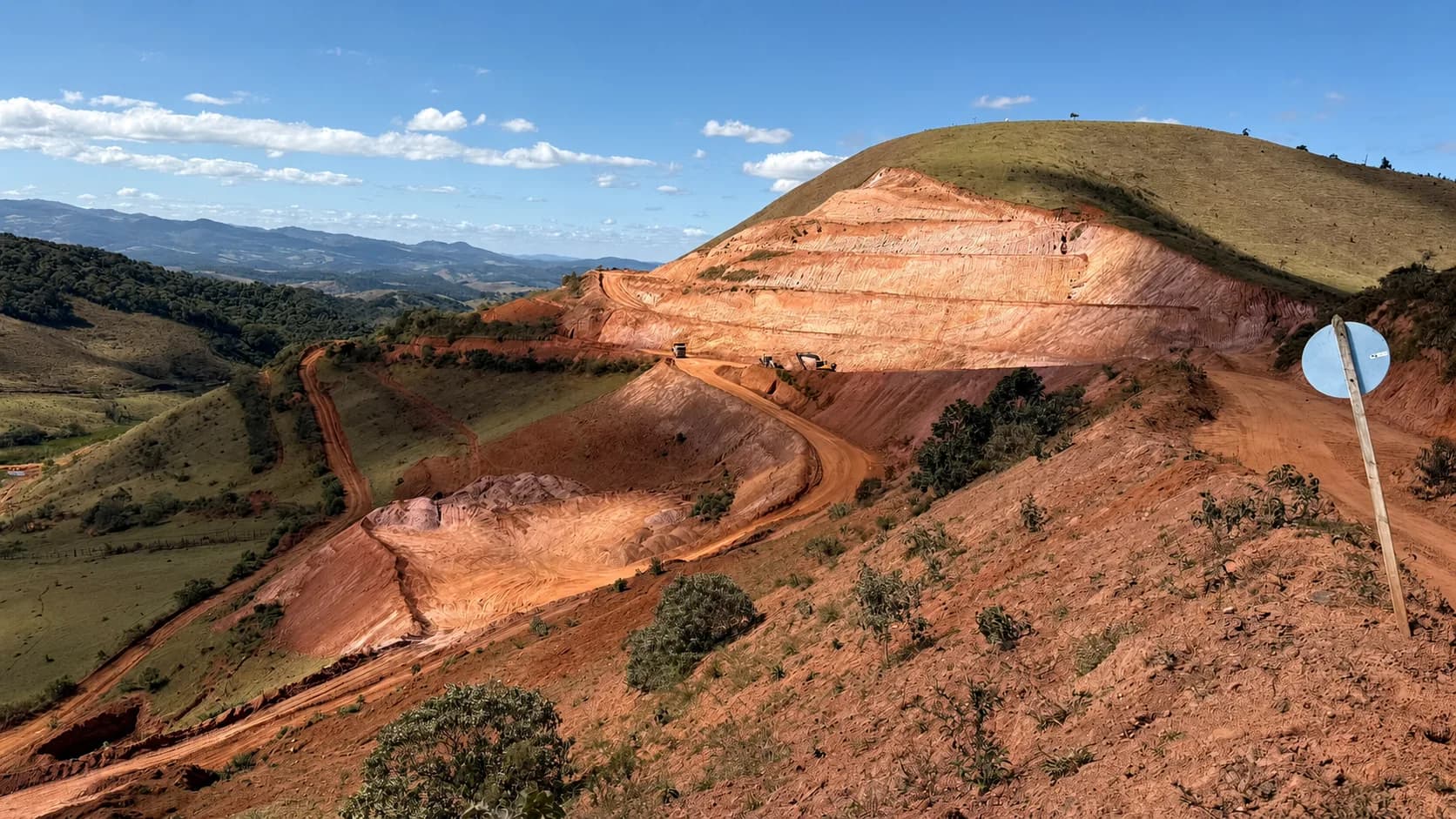
The Carijós Mine extracts iron ore and has been in operation since 2023. It sits in Itaverava, Minas Gerais, in the southern portion of the Quadrilátero Ferrífero, about 10 km from the centre of Conselheiro Lafaiete and 100 km south of Belo Horizonte. Access is via the BR-040 southbound and, from Conselheiro Lafaiete to the site, along municipal roads.
The operation covers 42.68 hectares, of which 13.73 hectares are pit. The remainder is split between the stockpiles, the loading area, internal access and administration. Processing follows a dry route, with no tailings dam, a decision that lowers both environmental risk and operating cost.
An expansion project is under way to also produce manganese. Both substances occur within the same mineral right, in separate bodies, and that is how the exploration work treated them: with concentration tests specific to each.
Geology
The area lies within the Mineiro Belt, where crystalline basement rocks and Archean to Paleoproterozoic supracrustal rocks outcrop, hosting the iron and manganese mineralisation. The surroundings include the Itabirito granitoid, the Barbacena amphibolite and the Congonhas gneiss, units of the region's gneissic-migmatitic basement. The iron ore occurs in itabirites formed of thin magnetite laminae, partially martitised, alternating with iron oxides and, in places, quartz laminae. The magnetism is strong enough for a low-intensity magnet to hang from a hand sample. The region has been known for a long time: in 1901 the geologist Orville Derby defined the Conselheiro Lafaiete Manganese District, and the iron occurrence was described in detail in the geological literature of the 1970s.
Mineral exploration and processing
- Detailed geological and structural mapping
- Surface rock sampling and geochemical analysis
- Interpretation of an airborne magnetic survey
- Acquisition and interpretation of ground magnetometry
- Trenching and trench mapping
- Detailed topographic survey
- Diamond core drilling, with logging and sampling
- Bench-scale technological tests for iron and manganese concentration
- Environmental studies
Processing route
The planned route combines crushing, screening, gravity concentration and magnetic concentration. Characterisation tests indicate that this ore does not require a grinding stage, which removes the most energy-intensive equipment from the process. The current installation comprises a scalper screen, crushing, screening and magnetic separation, which separates the ferrous minerals with high magnetic susceptibility. The pit operates dry, and the project has no tailings dam.
Technical record
- Substance
- Iron ore
- Expansion
- Manganese (project under way)
- Municipality/State
- Itaverava / MG
- Cluster
- Carijós / Barbacena
- In operation since
- 2023
- Total area
- 42.68 ha
- Pit area
- 13.73 ha
- Road access
- BR-040 · 100 km (Belo Horizonte)
- Rail terminal
- 10 km (Buarque de Macedo)
- Infrastructure
- Plant, product yard, access roads, truck scale, gatehouse and accommodation installed and commissioned
- Drilling under way
- 28 holes and 2,712 metres, with 9 completed
- Processing
- Dry process, with no tailings dam
Gallery

PROJECT LEADERSHIP
Francislene Almeida
MINING ENGINEER
Francislene Almeida is a Mining Engineer, with a technical qualification in Mining and an MBA in Contract, Cost and Budget Management. She has solid experience in the mineral sector, working across operations and ore processing, management, planning, infrastructure and team leadership.
Over the course of her career, she has developed experience in contract management, production, costs, budgeting, CAPEX, OPEX and contractors, combining technical knowledge with strategic vision to advance safety, efficiency, quality and continuous improvement.
The team in the field
The first photographs of the Carijós Mine team, taken at the operation itself.